Taylor Swift's SNL Cameo: A Masterclass in Narrative Control
Taylor Swift's 'Saturday Night Live' appearance alongside Dakota Johnson highlights her unparalleled ability to weave personal experiences into public entertainment, proving her enduring dominance in pop culture by controlling her own story.
Photo: Christian Bertrand / Shutterstock.com
How does a celebrity maintain omnipresence, not just in the music charts, but in the very fabric of popular discourse? For Taylor Swift, it appears to be through a meticulously crafted blend of strategic artistic output and a willingness to playfully lean into her own public mythology. Her recent surprise cameo on 'Saturday Night Live' was not merely a friendly appearance; it was a potent reminder of her masterful control over her own narrative, transforming even her personal history into a shared cultural moment.
On October 3, during Dakota Johnson’s hosting duties on 'Saturday Night Live,' Swift made an unexpected appearance that immediately sent ripples through social media. Johnson introduced Swift as her “literal therapist” after joking about her own failed relationships. Swift, in turn, quipped, “I’m not your therapist, actually. You just show up once a week at my house with an empty bottle of wine and ask if I want some You flop on my couch and overshare, and every so often I say 'Damn, that’s crazy.'” The playful exchange continued with Swift joking about giving Johnson Pedialyte and having her security drive her home, after Johnson playfully remarked, 'Sleepover, yay!'. Swift then quipped, 'Then I give you Pedialyte and my security drives you home.' This exchange, reported by news.webindia123.com, was more than just a comedic bit; it was a subtle nod to the public's fascination with Johnson's dating life and Swift’s own history, handled with characteristic self-awareness. The appearance was also described as a 'sweet little payback' for Johnson's recent role in Swift’s 'Patient Zero' music video, which premiered just days prior at the MTV Video Music Awards, further intertwining their public narratives (Source 8, 10).
This playful engagement is a hallmark of Swift’s broader career strategy. For two decades since her debut single 'Tim McGraw,' she has consistently demonstrated an unparalleled ability to shape her public image and influence the entire music business. Industry analysts in 2026 continue to cite her as a blueprint for how artists should operate, from ticketing and streaming to release strategies and direct-to-fan engagement, rather than just an outlier (Source 1, 2, 4, 7).
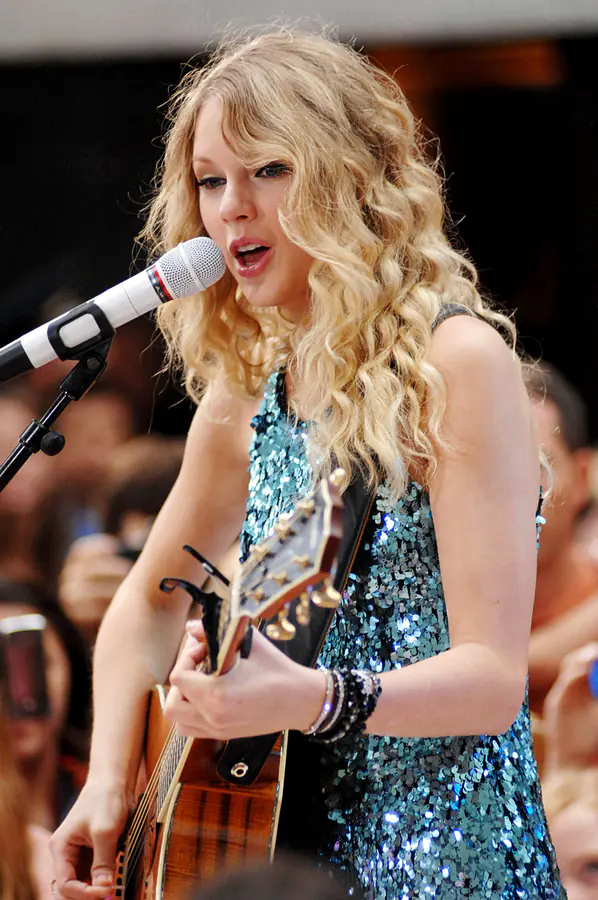
Her famous re-recording project, for instance, didn't just generate headlines; it ignited an industry-wide discussion about artists owning their masters, pushing more musicians to negotiate contracts with ownership terms in mind (Source 1, 2). This move was a clear assertion of control, reflecting a strategic approach she's maintained since the early days. As The Guardian notes, Swift understood that maintaining control would protect her career, fostering an authentic personal relationship with fans through her songwriting (Source 2). She famously stated in 2015, 'I feel no need to burn down the house I built by hand. I can make additions to it. I can redecorate. But I built this,' illustrating her constant evolution from country to emo to sleek pop, always owning her artistic direction (Source 2).
Despite being a globally recognized phenomenon and America's most visible celebrity in 2026, according to a study of 6.6 million media mentions, Swift maintains a largely controversy-free public persona (Source 5, 3). While a 2026 ROS Research LLC study found that only 23% of respondents viewed her as 'relatable,' suggesting her immense fame created a degree of distance, the same study confirmed her broad cultural influence and status as inspiring, intelligent, and talented (Source 3). Her SNL appearance cleverly bridges this potential gap, using humor to connect with audiences by playfully acknowledging the public's perception of her relationships and friendships. This strategic self-awareness allows her to navigate the complexities of mega-fame, ensuring she always has the last word on her own story, just as she did with the letter left on her ex's doorstep in her debut single's narrative (Source 2).
By integrating her personal narratives, artistic vision, and strategic business decisions, Swift has not only endured but thrived for two decades, setting new baselines for pop stardom and proving that true cultural influence comes from mastering one's own story.
No topics yet: start the first one.
More stories
Coughlan's Harry Potter boycott: silence is now a choice
Nicola Coughlan's refusal to touch HBO's Harry Potter turns actor opinions into brand risk, and the cast now has to pick between the franchise and what it says.
Olivia Cooke's social media exit isn't a stunt. It's a boundary
Olivia Cooke stepped away from social media over fandom toxicity. We think the real story is who gets to log off, and who has to stay.
Likability isn't a background check, and Walliams proves it
The collapse of David Walliams' family-friendly empire shows that a lovable persona is a product, not proof of character, and that networks and fans keep mistaking one for the other.
Celebrity AI ads can work, but only if the star holds the leash
CAA and Ogilvy's ECHO turns fame into a licensable asset. That's smart for talent, as long as consent is real and viewers can always see what's synthetic.